






Postnatal Mental Health: Recognising the Signs and Taking Care
An article by clinical psychologist Ana Beatriz Sousa explaining the importance of mental health after giving birth.
Read more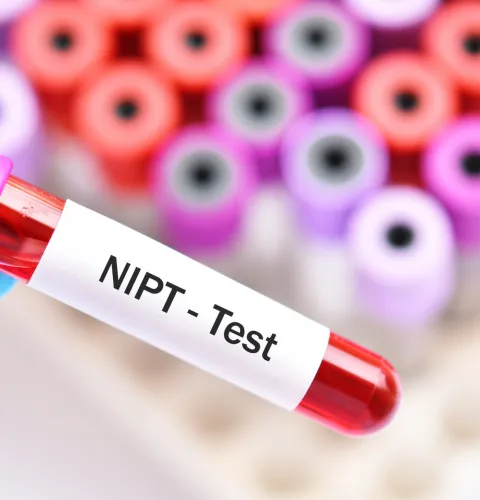
An NIPT – Non-Invasive Prenatal Test - is a test that can detect foetal chromosomal abnormalities with no risk to the pregnancy, requiring only a blood sample from the pregnant woman.
It can detect changes in the number of the baby's chromosomes: Trisomy 21 or Down syndrome (the test detects that the foetus has 3 copies of chromosome 21 instead of 2); the same applies to detecting Trisomy 13 and Trisomy 18.
The NIPT can be seen as a test that complements combined screening (maternal age + ultrasound scan), with the advantage that it can be done from the 10th week of pregnancy.
What method is used to carry out the test?
From a sample of the mother's blood, circulating DNA fragments are obtained, both maternal and foetal.
This is because, during pregnancy, small fragments from the foetoplacental unit enter the mother's bloodstream. These DNA fragments from the foetoplacental unit are usually referred to simply as foetal DNA. The test analyses these circulating fragments, corresponding to both the mother's and the baby's DNA.
Who is it for?
It is for all pregnant women! But it can be particularly beneficial for:
• Pregnant women over 35.
• Pregnant women at high risk of trisomies 21, 18 and 13.
• Pregnant women with a trisomy diagnosed in a previous pregnancy.
• Pregnant women with a history of repeated pregnancy loss.
• Pregnant women with ultrasound results suggestive of the chromosomal disorders tested.
• Pregnant women who would like to know more about their baby.
It can also be carried out in IVF/egg donation (own eggs or donor eggs).
Article written by the Mamãs Sem Dúvidas Team, with technical validation by BebéVida.
An article by clinical psychologist Ana Beatriz Sousa explaining the importance of mental health after giving birth.
Read more
Getting back into exercise after giving birth can be a challenge. This article answers the most common questions.
Read more
Comments (0)
Be the first to comment on this article.