





Postnatal Mental Health: Recognising the Signs and Taking Care
An article by clinical psychologist Ana Beatriz Sousa explaining the importance of mental health after giving birth.
Read more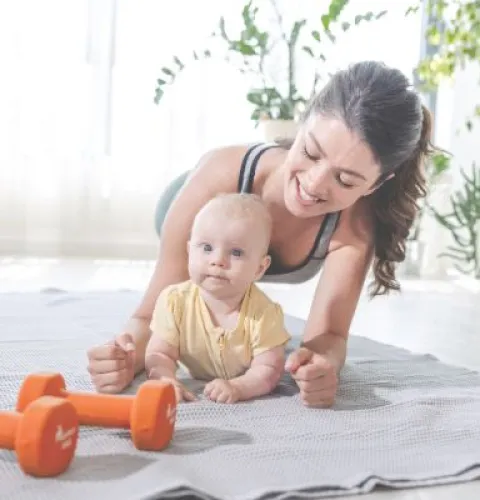
Getting back into exercise after giving birth can be a challenge.
Because your routines have been broken and had to change with the new reality of your baby's arrival. Whether you like it or not, you no longer have full control over your time and you've become a "hostage" to their needs. But also because of a lack of confidence and trust in your body.
At the same time, however, it can be a refuge — time that is just yours, a chance to start looking after yourself again.
And the truth is, that's exactly what it is!
After becoming a mum, your body does change, yes. But that doesn't mean you can't go back to how you were before, or even be better!
Exercise that is adapted and specialised for this stage will not only help you regain your confidence and wellbeing, but also help you become functional again and restore your body to how it was before.
In this article I answer the most common questions: when can I start again, where should I begin, how do I recover my tummy, and what kind of training can I do so that it fits into my new routine.
When to start again
My first piece of advice is always to start again only after your first postnatal medical check-up and/or an appointment with a pelvic health physiotherapist. That way you have the green light that everything is fine internally.
Then the question I ask is: what kind of birth did you have?
If you had a vaginal birth without major complications, after two weeks you can already start becoming more active. From four weeks, in most cases, it's completely safe to get back to it.
If you had a caesarean, from four weeks you can gradually resume your activity, and by six weeks you can usually do a lot.
However, as long as there's no pain, there are things you can do straight away.
Where to begin
As soon as you feel no pain, either in the pubic area or in your stitches if you have them, you can start reactivating your body.
Through deep breathing and abdominal contractions, dynamic and controlled stretches mainly of the upper body (shoulders, upper back, lower back…), and short walks (10 to 30 min), on flat ground if possible.
Simple things, but they will be essential for your wellbeing in these early days.
After the "normal" time I mentioned above, you can and should start doing mobility, functional and strength exercises. Especially if you're breastfeeding, you'll feel that your muscles go through a big change, and the sooner you start "counteracting" that, the better.
How to recover your tummy
Diastasis recti (separation of the rectus abdominis muscles) is physiological and inevitable. However, in most cases it is fully recoverable if it's corrected in time and in the right way.
What to do: choose exercises for the deepest layer of the abdominals (transversus), such as breathing, abdominal activation, adapted planks, balance movements, exercises involving grip…
What to avoid: abdominal strength exercises such as crunches and exercises with external load, jumping and high-impact movements, and high-intensity strength training.
Recommended type of training
Right now your time probably depends a lot on your baby, so I always recommend quicker but complete workouts, so that you don't skip them. And, at first, at home, so there's no "excuse" of travelling or not having anyone to look after your baby.
Make the most of naps, or use your baby as a weight — it ends up becoming a lovely moment for the two of you.
Always structure your workout to include every component: mobility, functional training, cardio, strength training and abdominal activation.
To get started without spending too much time, I recommend working to a timer rather than counting repetitions. And doing circuits or supersets so you don't need to rest as much. It's a way to increase the intensity and get more out of your workout.
Two sets and two to three exercises for each component is more than enough.
As soon as you're able to, I really recommend going back to or joining a gym.
Strength training is essential at this stage of life, because without your muscles you'll never be fully functional. And believe me, you'll feel the difference — in your wellbeing, energy and stamina for everyday tasks, as well as in your confidence and self-esteem.
Of course, this stage of your life is very specific and special and should be treated as such. So always ask a professional who specialises in this area for help.
If you need anything, you know you can count on me.
Article written by Joana Pereira | Exercise Physiologist Specialising in Pregnancy and Postpartum | Barrigas Felizes
An article by clinical psychologist Ana Beatriz Sousa explaining the importance of mental health after giving birth.
Read more
Pelvic physiotherapy has gained prominence in recent years in healthcare focused on female fertility.
Read more
Comments (0)
Be the first to comment on this article.