






Preparing for the Return Home and Your New Routine with Your Partner
Going home after the birth can be one of the most symbolic moments of the postpartum period. Prepare for it in the best possible way.
Read more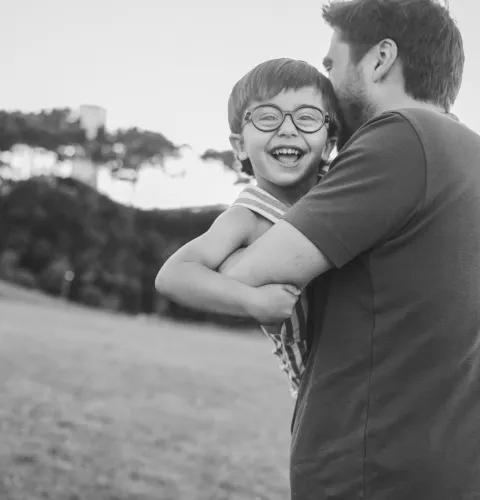
How important is the father's role in the development of communication?
And could the father be a key piece in our little ones' development?
From ‘Goo Goo Ga Ga’ to Big Conversations: The father's role in child development goes far beyond what many imagine! His active presence influences the child's language, cognition and behaviour.
In speech and language therapy, we know that communication begins before words – through play, conversations and shared meals. Every interaction counts towards healthy growth!
From its origins until quite recently, humanity has assigned the role of parenting almost exclusively to women. The very word maternity goes back to its Latin root maternitas, maternitat-is, derived from mater, meaning mother. Even so, many still believe that the mother plays a more dominant role in bringing up children, while the father figure takes a back seat. Society itself often reinforces this idea, relieving fathers of active responsibility for their babies' development. But the truth is that the father plays a fundamental role in building the baby's emotional, cognitive and communication foundations. Not to mention that responsibility is shared and, as a result, both parents are more available for the relationship.
When a father is absent or barely involved, the baby may miss out on essential connections and learning, which directly influence their development for life. And this is where the father's role becomes essential.
Science holds that the FATHER plays a fundamental role in the baby's overall development, influencing many areas of their growth.
According to Silva and Almeida (2022), the father's active presence contributes to the child's emotional wellbeing, encouraging healthy relationships and positive self-esteem, which supports healthy socio-emotional development.
Fathers' interests, being different from mothers', tend to stimulate curiosity and critical thinking in other areas, which, according to Costa et al. (2021), makes learning easier and consequently improves school performance, a major contribution to the baby's cognitive development. In terms of behaviour, we also know that a father's involvement is associated with more adaptive behaviour and less deviant and challenging behaviour.
From an early stage, Martins (2019) tells us that the father plays a crucial role in shaping the child's identity and ability to socialise, often acting as a behavioural role model. One of the key points to remember, and one that science has looked into, is the father's vital importance in supporting the mother emotionally. The emotional support and presence of an involved, proactive father is reflected in a harmonious, calm family environment, which results in a settled, calm and healthy baby.
It is important to note that the quality of a father's involvement, marked by affection, support and setting boundaries, is essential for a child to grow up healthy and happy (Rodrigues e Lima, 2021).
Daily interaction between father and baby has a direct impact on the development of communication. Whenever a father talks, sings or plays, he is creating an environment full of stimuli that support language. We know that babies who grow up in homes with more conversation and interaction have a richer vocabulary and find it easier to put sentences together. Something as simple as describing what is happening – “Let's put your jumper on!”, “Look at the red car!” – gives the child important language context. Even if they can't talk yet, the baby is absorbing and processing every word, expanding their emerging language repertoire. But communication goes far beyond speech. Eye contact, gestures and facial expressions are key for the baby to understand the intention behind the words.
By interacting with the baby in an expressive, engaging way, the father teaches them to read emotions, form social connections and respond to different stimuli. Games like “peekaboo” are great for practising turn-taking in communication – an essential skill for language development.
And then there's play – perhaps the most natural and effective way to encourage communication and emotional bonding. Whenever a father joins in pretend play, reads stories or imitates sounds, he is giving the baby new ways to express themselves.
Babies learn a great deal through observation and imitation, and the father is one of the most important role models in this process.
Mealtimes are also a wonderful opportunity to encourage communication and oral motor development. It isn't just about eating – it's about exploring flavours, textures and movements that will later be essential for speech. How food is presented, the interaction during the meal and the freedom to touch and try things all contribute to more balanced overall development.
By being present at these moments, the father makes the baby feel secure and helps make feeding a natural, positive process. More than just being there, a father has a huge impact on his child's growth.
Every game, every conversation, every shared meal creates a safe, stimulating environment where the baby can explore, learn and develop at their own pace. Because at the end of the day, communicating isn't just talking – it's building bonds, strengthening trust and opening doors to a world full of discoveries.
With all this in mind, how wonderful it is to have a DAD who lets us discover the world and create memories full of love!
By Joana Nápoles, Speech and Language Therapist & Feeding Specialist
Going home after the birth can be one of the most symbolic moments of the postpartum period. Prepare for it in the best possible way.
Read more
Breastfeeding after breast cancer is, above all, a story of hope. It is about believing once again in the strength that lives within every woman.
Read more
Comments (0)
Be the first to comment on this article.