






Preparing for the Return Home and Your New Routine with Your Partner
Going home after the birth can be one of the most symbolic moments of the postpartum period. Prepare for it in the best possible way.
Read more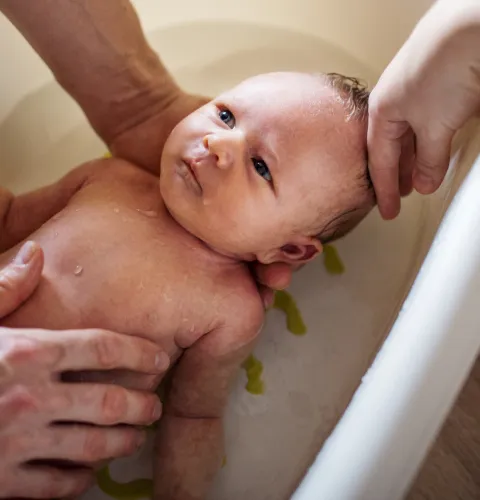
Bathing is an important part of your baby's hygiene, yet there are many myths surrounding it. Shall we clear up a few mysteries?
Under 6 months, babies get very little dirty, so they don't need a bath every day. Once they start eating and crawling, baths can be more frequent. Even newborns who still have their umbilical cord stump can have a bath.
From 12 months, babies can start to take part in their bath.
By 24 months they become more independent and the parents' role can start to be more hands-off, encouraging the child to wash themselves, always under supervision.
Babies who can't yet hold their head up well need it to be supported at all times. If you're right-handed, we suggest passing your left arm behind your baby's head and resting it on your forearm, holding their right shoulder with your left hand.
Baths should be short; for the little ones, no more than 3 to 5 minutes. The last area to be washed should be the genitals, because it's the dirtiest! The head should also be left until the end, because babies lose a lot of heat through it.
As for products, always choose ones suitable for babies, with a neutral pH and no irritants. There's no need to use both shampoo and body wash; one or the other is enough to wash the whole body.
When running the bath, start with cold water and only then add hot water, so the bath doesn't get too hot. Mix the water well! The ideal temperature is between 36 and 38 degrees. To check the water is at the right temperature, you can use a thermometer, but you should also test it with the back of your hand or your elbow.
You shouldn't use toys such as bath ducks. If you look closely, all these toys have a hole underneath where water gets in. Inside, they develop a black layer that is the perfect breeding ground for bacteria and can cause serious illness in your baby!
I've left the most important point until last, and it's about safety: never leave a baby alone in the bath! It only takes a few seconds and a few centimetres of water for a baby to drown. Don't forget this golden rule, and happy bathing!
Article written by Paediatrician Dr Inês Claudino, founder of the Dona Bebé project.
You can find out more about her project on her Instagram and Facebook.
Going home after the birth can be one of the most symbolic moments of the postpartum period. Prepare for it in the best possible way.
Read more
Breastfeeding after breast cancer is, above all, a story of hope. It is about believing once again in the strength that lives within every woman.
Read more
Comments (0)
Be the first to comment on this article.