





Preparing for the Return Home and Your New Routine with Your Partner
Going home after the birth can be one of the most symbolic moments of the postpartum period. Prepare for it in the best possible way.
Read more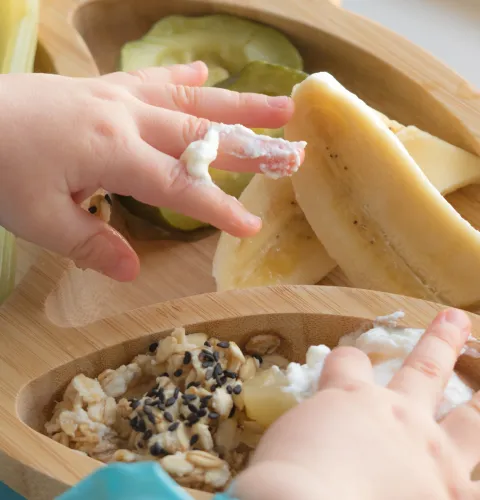
Baby-Led Weaning (BLW) could be described as starting complementary feeding guided by the baby, or on demand, because the baby shows signs of being ready to have foods other than breast milk or formula.
Introducing solids happens in the most natural way for them: babies lead the process themselves from the start, self-regulating, with countless benefits for the whole family, encouraging their independence and respecting their pace and choices at mealtimes.
BLW is already very common in other countries as an alternative to the traditional approach, with clear benefits.
The baby sets the pace for introducing healthy, safe and varied foods, which are offered in their natural form, without purées or baby cereal, encouraging the baby to touch them and bring them to their mouth with their own hands, on their own initiative. This builds the baby's confidence and independence by respecting and paying attention to their individual needs.
This approach gives excellent results in how babies learn about and accept foods, making their introduction a natural and successful process.
BLW encourages eating as a multisensory experience, in which the baby enjoys the colours, smells, tastes and textures of food in their own way.
It promotes family mealtimes, allowing babies to share and take part in them and in the food served, as they learn to feed themselves by example. The family improves its eating habits and saves time by preparing the same food for everyone, suitably adapted.
As an innovative approach, BLW responds to some of today's problems and needs in more developed societies. That's why families look for newer approaches like BLW, because they feel they meet the needs of today's babies. More and more, people are looking for approaches that protect them from disease and obesity and that are more sustainable.
In terms of parenting, parents see their baby as a unique person with needs of their own who requires individual stimulation. That's why they want to learn to read their babies and understand what they need, at each moment, to grow up healthy. And BLW is a way of introducing food to babies in which the baby leads us, according to the hunger and fullness cues they feel, rather than the parents' rigid rules: the baby lets us know when they're hungry and when they're starting to feel full. It's a way of feeding based on respect for the baby's instincts that also encourages their independence. Parents have every interest in their babies developing their abilities as much as possible, and this method helps them with that too.
Mealtimes should be a time of learning and love. A time when we look into our babies' and children's eyes and have a pleasant conversation. The WHO says exactly this, and I couldn't agree more, even if it seems at odds with the times we live in, when we're all in a hurry, but we can stop and enjoy the best thing we have in life: our baby developing as an individual.
Article written by Maria Fernandéz, Nurse Specialist in Maternal Health and Obstetrics
You can find out more on her Instagram.
Going home after the birth can be one of the most symbolic moments of the postpartum period. Prepare for it in the best possible way.
Read more
Breastfeeding after breast cancer is, above all, a story of hope. It is about believing once again in the strength that lives within every woman.
Read more
Comments (0)
Be the first to comment on this article.