






Preparing for the Return Home and Your New Routine with Your Partner
Going home after the birth can be one of the most symbolic moments of the postpartum period. Prepare for it in the best possible way.
Read more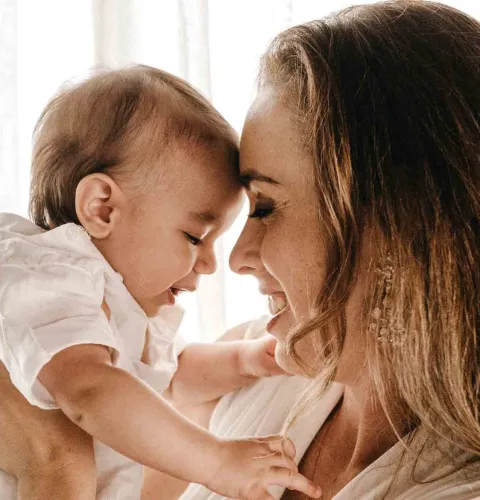
Childhood is a crucial stage for acquiring a range of motor, cognitive and social skills. Skills that will, in time, make countless personal and professional achievements possible.
In this sense, childhood is the stage when parents should pay the closest attention to all of their child's achievements, so they can spot discrepancies in development. It is as simple as observing your child, in an informed way, while they play, eat or explore the environment around them, bearing in mind a few aspects we will cover.
Monitoring child development is a key tool for identifying whether your child is acquiring the expected skills at each stage of development. As well as allowing any delays identified to be addressed, this monitoring is also reassuring for parents who, by observing their child conscientiously, will gain an in-depth knowledge of their abilities.
To support healthy development in your child, you should pay attention to:
1) Pace
Each child has their own pace of development. This pace should be respected so that each skill is acquired effectively. To acquire skills, a child has to go through several steps - observing/feeling the need, imitating/trying, doing and understanding - and at each step the child needs their own time to move past it; the process cannot be skipped or rushed.
2) Sequence
A child should go through each stage of development in a regular sequence. This means that the stages of development are sequential.
This sequence follows the increasing complexity of the actions to be carried out, which require simpler skills to be acquired first.
It is hard to imagine anyone learning to tie their shoes without first mastering gripping the laces with just the thumb and index finger.
3) Dependence versus Autonomy
For healthy development, a child has to experience a dynamic of dependence and autonomy. To feel the security that their parents' response to their needs provides, without losing the autonomy they need to explore, try and make mistakes.
It is essential to find a balance between the child's need to discover the world around them and to feel safe in the knowledge that nothing serious will happen to them.
The question to ask yourself in this case is: is the risk too great, or should I let my child run, explore and possibly take a little tumble?
4) Stimulation
Child development happens as the child grows and develops according to the environment they live in and the stimuli they receive from it. Through these, and through interaction with objects, other people and their surroundings, the child discovers, interprets and understands the world, while developing their motor, cognitive, emotional and social abilities. A child who is not stimulated or motivated at the right time will find it harder to acquire the skills appropriate to their age group.
5) Affection
Last, but of the greatest importance, is affection. The quality of relationships in early childhood is the foundation for a child's entire development as a human being. They are the basis of who they are. This is how a child gains confidence and self-esteem and, in turn, the courage to explore the world around them.
Children who are not given an affectionate family environment, and who are not given positive reinforcement when they complete a task, tend to be shyer and more insecure. On the other hand, children who are told “well done, you did a great job” tend to be confident and to face challenges more independently.
It is important to keep an eye on your child's development, monitoring it so that you are spared unnecessary anxieties and fears.
The thought of assessing your child's development can be a little daunting. However, it is through assessing child development that it is possible to determine whether everything is progressing normally or whether any developmental factor needs attention.
A formal assessment may be carried out after parents have noticed some discrepancy in their child's normal development, or it may simply come from wanting their child's development to be monitored by a professional.
However, always bear in mind that small developmental delays may not be significant and can be quickly corrected with good stimulation and a positive environment.
Article written with the support of Dr Ana Ferreirim Lopes, Psychomotor Therapist and member of the “+Eu Desenvolvimento Humano” Project.
Going home after the birth can be one of the most symbolic moments of the postpartum period. Prepare for it in the best possible way.
Read more
Breastfeeding after breast cancer is, above all, a story of hope. It is about believing once again in the strength that lives within every woman.
Read more
Comments (0)
Be the first to comment on this article.