






Postnatal Mental Health: Recognising the Signs and Taking Care
An article by clinical psychologist Ana Beatriz Sousa explaining the importance of mental health after giving birth.
Read more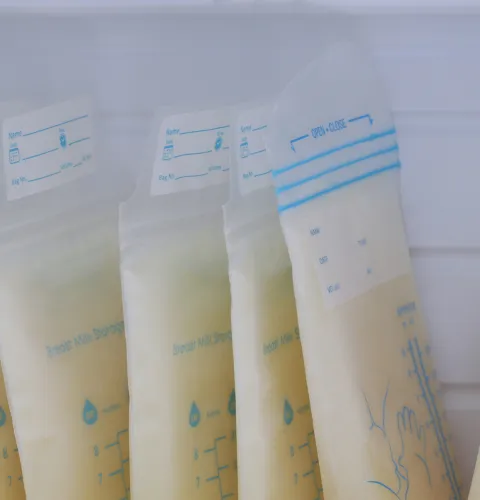
Breast milk can be thawed in the fridge overnight, for example, or under cold running water. Gradually increase the water temperature so that the milk warms up to the right temperature.
Once completely thawed, breast milk can be kept at room temperature for a maximum of 2 hours, or in the fridge for up to 24 hours.
Tips
Don't let breast milk thaw at room temperature.
Don't thaw breast milk in the microwave or in boiling water. This can damage its nutritional and protective properties and create hot spots that could burn your baby.
Never refreeze thawed breast milk.
When stored, human milk may separate into a milk layer and a fat layer – this is normal. Swirl it gently to redistribute the fat before giving it to your baby.
How should you warm the milk?
Healthy full-term babies can drink breast milk at room temperature or warmed to body temperature. Some have a preference; others don't mind.
To warm your milk, place the bottle or bag of breast milk in a container of warm water for a few minutes until it reaches body temperature (37 °C).
Alternatively, use a bottle warmer.
Important: never use a microwave to warm human milk. It can cause the milk to lose some of its beneficial properties; it also heats liquids unevenly and can leave hot spots in the milk container, which can be dangerous for children because of the risk of burns.
Sometimes thawed milk can have a strange, metallic smell or taste. This happens because the fats in the milk break down. The milk is safe and most babies will drink it without any problem. If there is a rancid smell due to excess lipase (an enzyme that breaks down milk fat) – a process that helps prevent the growth of harmful bacteria – the guidance from “ La Leche League International” is to scald the expressed milk (without letting it boil), then cool it quickly and freeze it. This deactivates the lipase enzyme, and this milk is still a healthier choice than formula.
If the mother or baby has an infection/thrush, you should keep breastfeeding during the outbreak and treatment. During treatment, the mother can continue to express her milk and give it to the baby. Be aware that refrigerating or freezing milk does not kill yeast. Once treatment is complete, all the milk expressed during the infection should be discarded.
Article written by Carmen Pacheco, Nurse Specialist in Maternal Health and Obstetrics and founder of the Mãe.Ponto project
An article by clinical psychologist Ana Beatriz Sousa explaining the importance of mental health after giving birth.
Read more
Going home after the birth can be one of the most symbolic moments of the postpartum period. Prepare for it in the best possible way.
Read more
Comments (0)
Be the first to comment on this article.